This post is not meant to be a detailed guide on installing and configuring Jekyll; for that, there are excellent guides listed below.1
Instead, this post is a commented collection of notes I took while developing melabit.com/posts/en. They are the result of days and days of trial and error, changes in direction, and research to find the right command. These notes were useful for me to remember what I had done and how I had solved the issues that arose from time to time. They might be useful for you to get everything done more quickly and smoothly.
– Image generated by Microsoft Designer AI.
In the past few months, I have written four posts about macOS Sonoma bugs (a complete list is at the end of this post) because I found it unbelievable that this macOS version was released with such glaring issues in the Finder and in disk management.
– Source: Apple Support.
Experimenting can sometimes lead to issues. That’s exactly what happened to me after a failed macOS installation, which resulted in a big question mark with a prompt to visit the Mac restore page.
For some years now, when a Mac is unable to boot macOS and cannot even run macOS Recovery to repair or reinstall the OS, the only way to bring it back to life is to enable DFU Mode (Device Firmware Upgrade). This mode is stored in ROM and cannot be erased under any circumstances.1
– Image generated by Microsoft Designer AI.
Sonoma’s bugs never fail to surprise, and here I describe a fresh one, which luckily has been fixed in Sequoia.
Take a new MacBook Air or Pro, where you’ve just installed Sonoma, or a MacBook where you erased the startup disk before installing Sonoma (what happens when simply updating from a previous version might be different).
– Image generated by Microsoft Designer AI.
A couple of months ago, I listed some more or less serious bugs in Sonoma that I noticed while getting familiar with the latest version of macOS, first on the new Mac Studio M2 Ultra and then on the household Mac Mini M1.
At that time, I was using macOS Sonoma 14.3, which I soon updated on the Mini to version 14.3.1. With this minor release, Apple fixed a couple of the bugs I described, specifically the one about emptying the Trash into a random Space and the issue that prevented giving decent names to PDF files generated by the Print function.
– Source: Viktor Forgacs on Unsplash.
The transition is complete: since a few days, all the computers I use for work are running on Apple Silicon ARM processors. This includes a Mac Studio M2 Ultra, which I’ve already talked about extensively and which sits on my office desk; a Mac Mini M1 with 16 GB RAM and 1 TB SSD – previously neglected on a shelf for reasons I won’t go into here – now in my home office; and a very basic MacBook Air M1 (just 8 GB RAM and 256 GB SSD, half the specs of my wife’s) for light use and when I’m on the go.
– Image generated by Microsoft Designer AI.
Sonoma is still raw and comes with a fair number of bugs, but fortunately, there is something good here too.
As far as I’m concerned, I like that Screen Sharing has finally gained its rightful place on the Mac, taking its spot in the Utilities folder within Applications, instead of being relegated to /System/Library/CoreServices/Applications, as it had been until now.
– Image generated by Microsoft Designer AI.
In the last post, I described some very recent bugs present in Sonoma, the latest version of macOS.
The bugs reported here, however, have persisted across several versions of macOS, and it seems that Apple has no intention of fixing them or doesn’t even consider them to be bugs. These issues, unlike other reports, don’t occur under extreme conditions or after opening a zillion files but during completely normal use, which makes it even stranger that they’ve never been resolved.
– Image generated by Microsoft Designer AI.
I use my Mac for work, so I’m always reluctant to update macOS too quickly. I usually prefer to wait until the current version matures, and sometimes I skip it entirely, maybe because I’ve read particularly negative reports or because I wasn’t convinced after using it on a friend’s or colleague’s computer (as I did with Sierra, Catalina, and Ventura).1
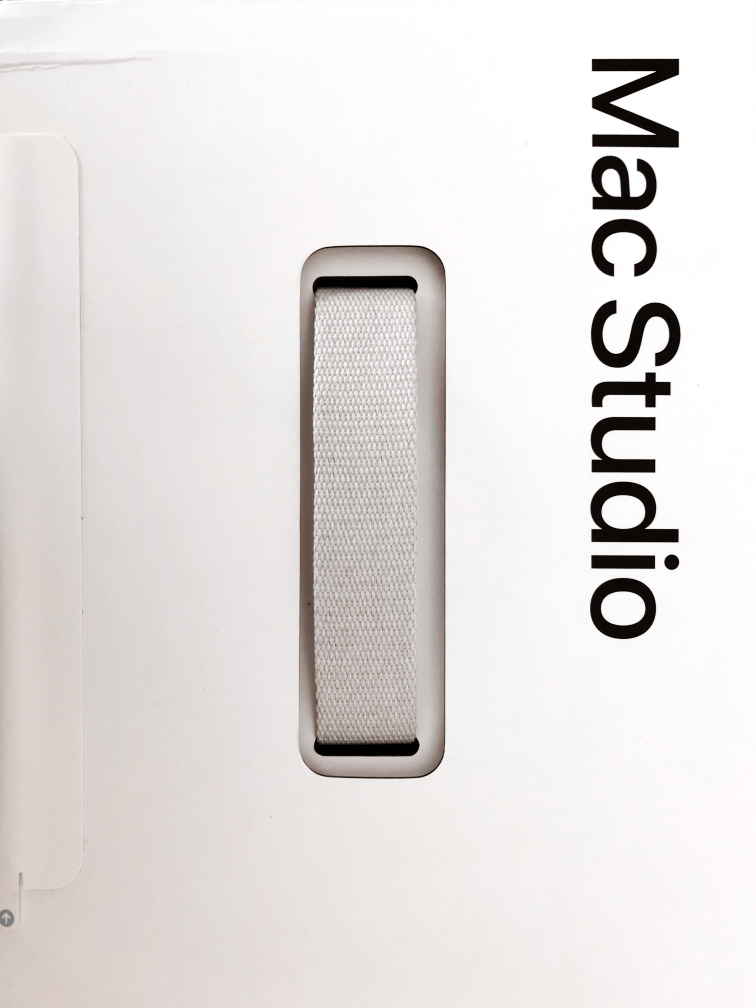
And here it is, the Mac Studio. I had to go through a long bureaucratic process to get it, but I finally managed, and now it’s right here in front of me.
The first thing you notice is that the box is heavy, very heavy. The specs state that the Mac Studio is large and weighs about as much as three Mac Minis stacked on top of each other (19.7 x 19.7 x 9.5 cm^3 and 3.6 kg for the Mac Studio versus 19.7 x 19.7 x 3.6 cm^3 and 1.2 kg for the Mac Mini). I’ve never held three Mac Minis together, but the box gives a strong impression of solidity, which is definitely a positive for such an expensive device.
 IT
IT
 EN
EN